Wednesday, February 4, 2015
cart before the horse
Wednesday, August 6, 2014
sayonara, and other pieces out of time

Thursday, June 19, 2014
language
Thursday, May 15, 2014
a good look
This may be the most disconcerting thing about being a gaijin, there is a clear line between inside and outside, and an irreconcilable tension between wanting to be unremarkable on the one hand, but visible and recognizable on the other hand.
Donald Richie sums up the feeling in The Inland Sea, "Like all Americans, like all romantics, I want to be loved -- somehow -- for my precious self alone."
*
![]() |
| study for Amie, 8 x 10", oil on paper |
I study my own face too, sometimes with bemusement, sometimes with cool apprehension. As with my art, I am eager to know what others see, at the same time that I feel embarrassingly exposed. What makes a good painting? What makes a face open, like an invitation?
When I go looking for mirrors, I get windows.
*
Tuesday, April 15, 2014
as we go
Wednesday, April 9, 2014
the essence of which
Thursday, March 27, 2014
hiding
Sunday, March 23, 2014
greening
I haven't been able to write anything about our life here... Every time I try, it seems preposterous, vain, loaded with haughtiness. And yet I read other peoples' blogs voraciously, desperate for the details of their lives.
I had a dream the other night that a friend asked how it had been living with my family in OUTER SPACE. It was hard, I effused, and described living in zero-gravity and how challenging it was to acclimate to Earth's atmosphere on the way home.
Even my subconscious is hyperbolic.
*
We took a walk after dinner in the twilight, to return the pine branches we used for our Christmas tree to the mountains, and it was so quiet and humid and soft, the kids giddy to be outside in the growing dark. I feel it too -- like I'm coming out of the long tunnel of winter, finally able to see what I'm looking at.
Auden graduated from Kindergarten, speaks Japanese in the most adorable Kansai dialect, is dead-serious about anything having to do with directing and/or performing, and is also suddenly interested in science.
Isla prattles on and on, paragraphically, in English as well as something that sounds just like Japanese but isn't, quite. She is a dreamer, a dally-er, an enthusiastic describer of nonsensical details. We are constantly telling her to stop shouting.
We ride our bike-for-three every day, me sandwiched between them, huffing and puffing up hills while they argue about song lyrics and discuss the characteristics of momentum. They blow kisses to gaggles of schoolgirls, which results in a collective squeal of delight and is endlessly amusing.
Day after day: put away the futons, step down into the kitchen, make the coffee, send the kids off, ruminate over colors, collect the kids, squabble and laugh, make the dinner, protest and cajole, put out the futons, read the stories, breathe and rest.
Saturday, December 21, 2013
christmas claw
Sunday, November 10, 2013
reading the air
I want to keep painting with the same gusto I mustered over the summer, keep going with the delft and the patterns and the layers. But I am still sort of shocked and disoriented, and can't account for why the brushes won't work, why the paint won't move.
I listen and listen to people, waiting for the words to make sense, waiting to feel settled and acclimated. But the explanations I want, the connections I want, are maddeningly out of reach. I assume automatically that my art suffers because of this disorientation, but what if art is actually the way through it?
I feel scared, reluctant. Still struggling to find a rhythm in these days. I want to paint, but then I want to shop, decorate the house, write letters. Everything is all jumbled together and resists being sorted.
But I must commit to making art, and not trouble myself so much about what will come of it. I don't even need to deliberate about what to put IN... it's just going to happen.
Five hours a day is short -- I have to start in right away if I want to paint, and even then I'm working up to the last minute before I have to pick up the kids. How will I get anything done this way? There's so much I want to do -- that ever-present ache -- and I can't get organized to actually do it. These little scraps of time, scraps of art... how can I commit when as soon as I get warmed up it's time to stop?
My mind is jumping around so much, overfull, focusing on nothing, like a dream I can't quite remember. I can't wait for the world to stop rushing in , I have to close the doors. Trust the quiet.
Is this how we spend our days, we humans? We wake up in this world that has air and water and light for us, a world that grows food for us to eat! What a marvel! And then we worry and worry and worry.
*
Monday, October 21, 2013
stop worrying, love the bento
(*had nothing to do with "teaching")
I would eat with the students, and marvel at their little zig-zag cut cucumber slices, their broccoli spears topped with a smattering of sesame seeds, their tiny patterned foil cups filled with coiled noodles... and they would make fun of me for my unabashedly boring leftover curry..
But, come to think of it, they made fun of me for just about everything. Aren't kids delightful?
So I had some trepidation about this lunch-making business. Getting tips from cookbooks specifically for bento is like taking a crash-course in master-chefsmanship... learn to prepare tiny portions of savory and aesthetically appealing finger food, nutritionally balanced and artistically nuanced:
Roasted eggplant slices interspaced with prosciutto! Glazed grilled salmon and bite-sized chunks of boiled kabocha! Apples sliced like an MC Escher drawing!
Gorgeous little hors d'oeuvres. For your child. FOR LUNCH.
I flipped through the pages of that cookbook thinking my kids will not eat any of this.
But first, before I even got to the cooking part, I needed some things:
I can't even tell you how many different stores I went to for the proper napkins and little cups and pouches for little cups, but it was a lot, and I broke a sweat in all of them because the kids take my price-tag-reading and decision-making-face as a cue to escalate to full-on feral monkey mode.
But we made it out eventually, and everything is safely gendered and color coordinated, despite the hodge-podge of assorted cartoon personae.
To the kitchen, then, for my first attempt:
Fortunately the majority of the bento is supposed to be rice, and it's not hard to dress it up with some furikake. The fried-chicken was store-bought (cheating, yes), then sliced apples, clementine wedges, cucumber slices -- salted! that's the trick -- and some green beans, blanched, then simmered in miso paste.
This is not going to become a cooking blog, where I take well-lighted pictures of food I made in my impeccably tasteful house in order to make you feel bad about your life, heaven forbid -- I only need to illustrate my story to show you that my children ate these vegetables. My children. Who usually eat cheese crackers and hot dogs. After a week in Japanese Yochien they are willingly eating green things.
Attempt #2 was leftover chicken piccata, rice cooked in dashi with carrots & mushrooms (followed this recipe, more or less), gomae (sesame spinach), and some more cuke & apple slices.
I'm crediting peer pressure mainly, and also the utter lack of fall-back comfort food, as the reason my kids will even try this stuff. But I have also realized my own complacency in our previous lunch habits. I don't want to be all insufferable about it, but learning how to cook vegetables in a way that tastes good to my kids is a skill I didn't know I needed until I was forced into it. Having a toaster oven helps, too.
I did not expect to like making bento; I was only hoping for a grudging tolerance. Believe me, I have deeper issues about Japanese food in general that need to be resolved (how desperately I miss good bread, for example), but I'm giving myself permission to feel a little smug in my success on this front.
Don't expect cocktail wieners cut to look like octopi with little sesame seed eyes, though. I have some snark to maintain.
*
Friday, October 4, 2013
same river twice
So unbelievably tired at the end of the day; snapping at the kids, feeling guilty, always trailing behind, instead of marching, decisively, ahead.
More than once already I have wanted to bail on this adventure. It's getting easier bit by bit -- we have water pressure now! and a table! -- but it's still hard for me to imagine the coming winter and the rest of our year here. It's simultaneously a big deal and not at all... we're just going about our lives and our work, with the usual frustrations and successes. And yet, I'm indulging in self-pity, needing some recognition for the work I'm doing, because it feels like a magic trick every time I coax dinner out of the meager provisions in our fridge. I am flummoxed by the grocery store, vexed by uncooperative children who expect toys and treats just for breathing Japanese air.
I have been retracing old steps, stitching this city together from a dream. I am looking for the street that connects to the alley that leads to the cafe next to the charming gift shop... was that it? Do I also expect to find the person I was then?
I used to love rummaging around at used bookstores, searching for collage material. Yesterday I went to one in our neighborhood and browsed briefly through the offerings out front, a haphazard stack of mildewed books and periodicals. It didn't enchant me with possibility like it did before, it just looked like the remnants of someone's hoarding, coating my hands with filmy dust.
So, I had to get that out of the way, I suppose. Now I can allow this experience to unfold in real time, unbounded by my expectations. The kids and I ride our bike all over town, observing, piecing things together in a new way: here's the giant tanuki, there's the mossy little waterfall, here is our fox shrine. "We're meambling," Auden says as we coast slowly, letting the narrow streets lead us this way and that.
I want to force things to come together, to make sense, to be easy. I takes all kinds of reminders to slow down and see what's right there: delicate things, easily overlooked, like tiny maple leaves in a layered canopy, filtering sunlight.
*
Friday, September 27, 2013
ride
Buses & trains are fun and all, but THIS is freedom.
I used to marvel at the women biking around with multiple children strapped in to bike seats -- the Japanese Minivan. Now I AM THAT MAMA, god help me. And god help you, too, if you're walking or biking toward me.
*
Monday, September 23, 2013
upon arrival
Headphones, coloring books, a very small amount of sleep...
And suddenly, we are inside a tiny garden which is inside our house, on the other side of the world.
Kyoto smells like incense, cigarette smoke, laundry soap. Fish.
But, you know how you can't quite put your finger on it... Something vaguely medicinal? Something like damp tatami?
Everything is a jumble of memories... streets, sounds, words that surface before their meaning. It's overwhelming. How can I tell a coherent story? At least we are now sleeping through the night.
The streets are unbelievably clean. Our neighborhood is a labyrinthine network of narrow passages, the thing that so enchanted me before, this quiet, fragrant maze.
What I remember about this city is that its magic worked whether I was willing to believe or not, and I was transformed by it despite myself. Only a fool would get the same magic trick twice!
It's funny -- I'm at the same time more confident and more humble now than I was before. I used to try to maintain an aloof separation from other foreigners here, which is of course the mark of any insufferable gaijin. Now I won't conceal my curiosity or my magnanimity. Big, wide smiles! Knowing nods, which really mean, I don't know anything more than you do. I swear.
I was in a terrible mood the other day, wrangling whining children through the hubbub, resentful of the food I don't like and the language I can't fathom, and a little voice inside said, Don't waste your time feeling this way.
And I continued to have my quiet fit for a few more hours, but I knew it was right, that voice, because the sun was warm and we finally got a refrigerator and we discovered how to tease koi fish with pebbles, and there will be a rhythm soon, and I will feel silly for having wasted entire mornings fighting against the current.
*
Tuesday, May 28, 2013
where we go from here
And when distance calls, you get dressed...
And you learn to speak the language...
... and put everything in boxes and get ready to go.
So, yes, distance...
Japan!
How could we say no?
Even as hard as it is to pull up our nascent roots here, to maintain the momentum that gathers no moss, it is also unspeakably good to imagine navigating again the enchanted city of Kyoto, whose moss is composed, cultured, cultivated. We shall borrow hers, then.
Countdown to leave Providence has begun, and we have a lovely summer in Michigan ahead before we go abroad, so of course I am a jumble of sadness and nerves and utter giddy delight. How can it be true, this life?
It's less like stacking cards -- carefully, one on top of the last -- and more like flinging the deck and jumping on whatever lands face up. We keep moving: I keep making amazing friends and I keep taking classes and I figure that it amounts to something, somehow, but how do I hold it all? How do I assemble it and make it useful? Maybe it's less important where we go, and more important how we go from here.
*
Saturday, December 1, 2007
giving thanks

The pink one was a gift from J when we went to Jingoji Temple last weekend, the red ones are from friends; all charms to bless my pregnancy and wish me a healthy baby and safe delivery.
They've been hanging on a peg above my futon, bright little satchels of prayers I don't understand but nevertheless feel compelled to honor.
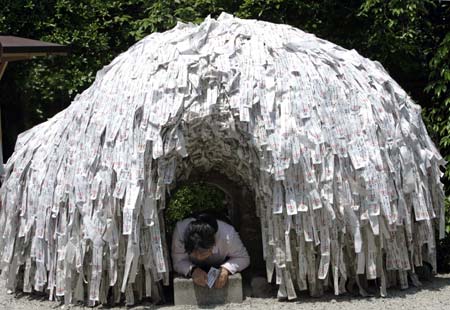
When I first came to Kyoto in 2005, Japanese Buddhism struck me as terribly superstitious: Students line up at Kitano Tenmangu, a Shrine dedicated to a deified (and once-exiled) scholar, to pray before their entrance exams; at Yasui Konpira-gu Shrine in Gion, lovers climb through a tunnel in a strange stone sculpture, plastered by years of omikuji, in order to initiate or terminate a relationship (depending on which way you go through); once a year at Sanjusangendo Temple you can get hit -- okay, touched -- on the head by a sacred willow branch to prevent and cure headaches. Then there are all the charms, the fortunes, the rubbing of bronze statues that will alleviate physical pains... Do people really believe all this stuff? I wondered.
But then, Christians do some pretty wacky stuff in the name of healing, too.
Is superstition just faith in charlatan's clothing? Believing in anything you can't see or prove is bound to strike someone as superstitious, right?
Still, I have faith. I have my patchwork religion, culled from childhood Bible stories, Annie Dillard, and long walks in the woods. I'm keen on coincidence, sure that god makes god-self known through fortuitous glimpses.
The Tuesday before Thanksgiving, J and I went to visit with a woman he'd interviewed for his research on spirituality and aging last year. She's a smart, lovely woman of 84, with lots of stories and a thick Kyoto dialect. I can barely understand her, but I wanted to go along anyway, be a good wife. She hosted us in the middle room of her home, a beautiful old machiya in Nishijin, the textile center of the city, where she still helps run a silk tie-making factory. After a while, as we started making motions to leave, she suddenly suggested we walk over to a nearby altar to Jizo, the Buddha who looks after children and travelers, to do a blessing for the baby. We obliged, and walked with her a short distance from her house, to an odd little clothing shop with the entrance to a house at the back. We followed her inside, and she greeted the elderly couple who lived there.
I have often walked into situations in Japan where I knew nothing of what was going to happen, and have learned to just open up to it. This is what happened:
Our friend took us to the open garden in the middle of the house, where there was a small altar around two ancient-looking stone Jizo -- actually, they looked like worn and faded rocks, not sculpted figures, distinguished only by the red bib that Jizo sometimes wears. They looked as though they'd been there far longer than the house itself, which sort of awkwardly accomodated them in a corner of the courtyard.
The elderly man followed us, and gave us candles and incense to light. Not quite knowing what to do, I followed J's lead and knelt at the altar, saying a silent thank-you. The man then had us sit behind him as he stood at the altar. We bowed heads and pressed palms together as he lit incense and began to chant the heart sutra: maka han ya ha ra mi ta...
I started to cry. Huge, urgent tears spilled out on to my hands before I knew what they were for, my body was shaking, my breath coming in short gasps. I couldn't stop it -- it was too big, too fast. When he was done, we got up and I tried to compose myself but couldn't. I was so moved, so amazed by the strength of the feeling. I fumbled with some syllables to articulate how grateful I was, but it came out all blurry through the tears. We went back to the front of the house, and I tried to say thank you some more.
The man decided to give us the prayer book he'd used for the chanting, and at first J tried to refuse, but the man explained that Jizo-sama wanted us to have it as a gift. He told me to rub my belly with it, and to put it under my pillow when I go into labor. It wasn't superstition, it was god, it was grace, it was the generosity of human spirit manifest inside a prayer book.
I cried on my bicycle all the way home. I felt as though I'd been lifted and struck like a bell, and was reverberating with the intensity of it. I hadn't understood anything that had been said, and I don't really understand that much about Buddhism; but despite that, and despite the fact that it all happened in less than five minutes, the power of the ceremony cleaved directly to the heart of me.
Since then, I am more grateful for the sentiment in the omamori; I stop and pray whenever I see an altar or a Temple for Jizo. I don't think I fully understood before what motivated people to have faith -- to pray before something and really believe. How often are we called like this?
I'm still trying to figure out how to say thank you.
*
Tuesday, November 27, 2007
when in Rome...
The Japanese have no such rule. I've asked several women about it, and they've never heard of abstaining from raw fish during pregnancy; in fact, my maternity handbook even lists sashimi as a recommended source of protein in the "food pyramid" scheme.
Last weekend, J and I accompanied Shohei and Tomomi to Kanazawa, a lovely city on the coast of the Sea of Japan -- home of the 21st Century Art Museum, and famous for its fresh fish. We planned to partake of both.
A recently pregnant friend of mine spent part of her pregnancy in Spain, where she heard it was just fine for pregnant ladies to have a glass of wine a day. I'm not saying this to flout doctor's orders, or to suggest that alcohol really has no affect on the baby and those mean male obstetricians just don't want us to have any fun during gestation; I just want to point out that different cultures have different um, wisdom about pregnancy.
It's up to you to decide which rules to follow when you're pregnant, but I was in Kanazawa, and I figured, When in Rome... And the suzuki sashimi was delicious.
The next day we spent playing in the museum, which was truly delightful with its bright open design and interactive installations. It seems that 21st century art is not about looking at a painting or a sculpture, but about being enveloped in a concept. Many of the exhibits took up entire rooms, some even required us to stand in line and view the piece two, three, seven people at a time.
Here's a wall hand-painted in the particular pattern of Kanazawa yuzen.
One of our collective favorites was The Swimming Pool, by Leandro Erlich. From above, it looked like a regular pool, but actually the water was a 10cm layer at the top of a glass-ceilinged room below.
From outside, it looked as though a crowd of people had sunk to the bottom, fully clothed and heavy as rocks. Once inside, you could look up at the blurry figures of people standing poolside, and imagine that you were looking up from the blue watery deep end -- but could still breathe!
Shohei loved the Blue Planet Sky exhibit: a vast empty room with a high ceiling and a square hole open directly to the sky. The idea was so simple, but its effect so enchanting -- a great box of light, a three-dimensional sky painting, of changing texture and hue, dappled clouds and passing crows -- that we went back a couple times to experience it both in the sun and in the pouring rain.
Shohei snapped this photo afterwards, catching the framed sky in a puddle.
My favorite exhibit was a room lined with panels of cardboard, each one bearing a giant painted seed, a catalogue of a variety of plants in Japan. The center of the room was occupied by three large cardboard ships, round and tall and sort of pointed at one end. Seeds are ships, the exhibit explained, traveling far and wide with their information and influence.
I was struck at once by the parallel of having a little seed of my own growing inside, and how amazing it still is to me that from the moment of his conception he contained all the information for his development in a tiny cluster of cells. My breath caught in my throat and I wanted to cry a little, but I fought back tears because it seemed silly to be so moved by cardboard.
But I was moved. I am moved by the potential in things; by growing things, things that start small and seem inconsequential, but unfold and unfurl and astound you with their complicated beauty. All that happens, all that is possible, comes from just a little seed.
We stopped for oden after the museum, warming our bellies on daikon, tofu, eggs, chikuwa, and seaweed before getting on the road to drive back to Kyoto.
It rained the whole time, as it should on the way home. I felt happy and sleepy in the back seat, basking in the richness of friendship and the exquisite satiation of art and food.
*